
Country Living Color by Number
ColorVerse Game StudioBoard
4.922.00 Reviews
- Version
- 1.0.5
- Installs
- 10.00K
- Age Rating
- Everyone
Screenshots
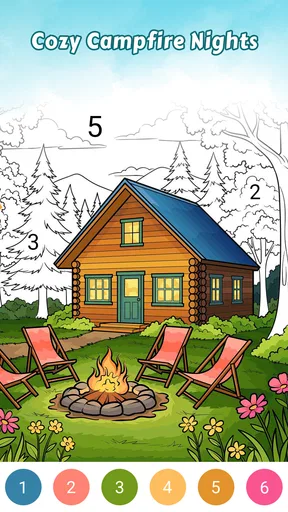
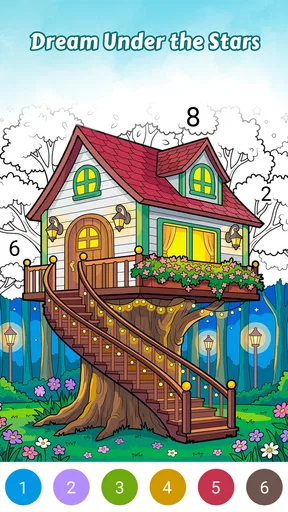
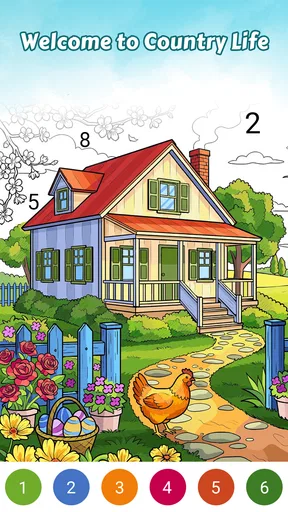
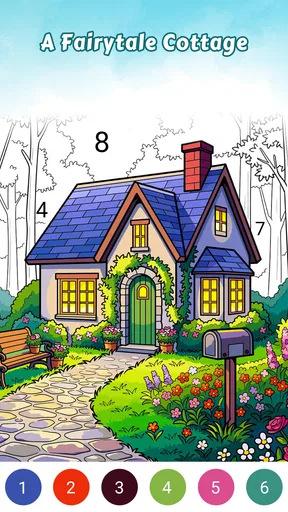
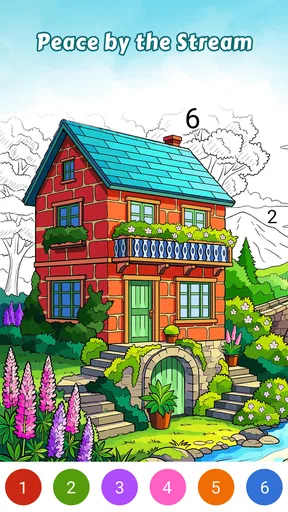
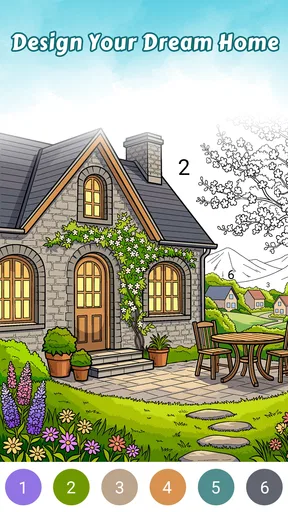
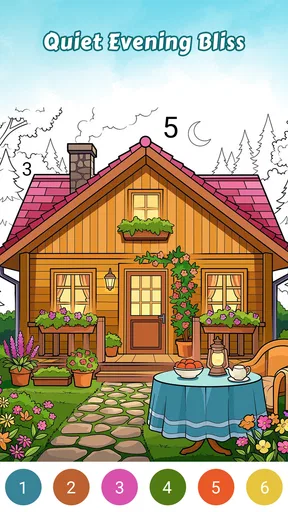
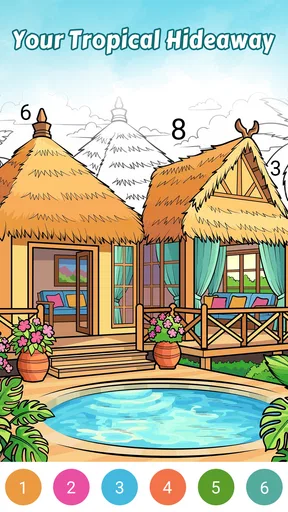
Our Review of Country Living Color by Number
 Analysis by Appyee
I spent time with Country Living Color by Number as a quiet, tap-based board game built around painting rustic country scenes. Its central idea is simple: instead of choosing colors freely or managing a complicated puzzle board, I filled numbered areas until each warm, homey illustration gradually came together. That narrow focus is also its identity. This is less a traditional competitive board game and more a calm digital coloring experience presented through a game-like structure.
The game comes from ColorVerse Game Studio and is free to start, with optional in-app purchases ranging from $0.99 to $39.99 per item. It is rated for Everyone, runs on Android 7.0 or later, and the current version is 1.0.5. Those details make it easy to approach, especially for families or casual players who want something gentler than a strategy game, although the purchase range is worth keeping in mind before handing the device to a child.
Why painting by numbers is the whole experience
The verified capability that matters most here is the ability to complete cozy country-living artwork with taps. In practice, that changes the mood of the game. I am not trying to beat an opponent, calculate a move several turns ahead, or react to a timer. I am looking for the next numbered section, tapping it, and watching the scene become more complete.
That structure gives the artwork a clear rhythm. Large areas provide quick progress, while smaller sections ask for more careful attention. A barn, kitchen corner, garden detail, or piece of furniture can look unfinished for a while, then suddenly feel coherent when the remaining spaces are filled. The satisfaction comes from completion rather than competition.
I found the numbered approach more approachable than a blank digital canvas. Free coloring can be relaxing, but it also asks me to make decisions about palettes, brushes, balance, and composition. Here, those decisions are reduced. The game guides my attention toward the correct area, leaving me to concentrate on the act of tapping and the gradual visual payoff.
The strongest reason to try it is its low-pressure sense of progress. Someone who enjoys rustic interiors, countryside imagery, or simple coloring activities can open it without needing to learn a ruleset. The board-game classification is useful in a broad sense, but expectations should be realistic: this is not a turn-based tabletop adaptation or a tactical board with opponents. Its board-like appeal is the orderly process of completing sections.
How the coloring flow feels during ordinary play
My most useful way to approach a picture was to avoid treating it like a task that had to be finished in one sitting. I would begin with a few obvious areas, pause when the image started to feel visually satisfying, and return later for the smaller details. That makes the game fit naturally into short breaks rather than demanding a long session.
The numbered method also creates a small visual search challenge. When several spaces remain, I have to scan the scene and decide where to tap next. That is not deep puzzle solving, but it prevents the activity from becoming completely passive. The more detailed the illustration feels, the more the final stage becomes a careful hunt for overlooked sections.
A useful tip is to work around the picture instead of repeatedly staring at one central object. Moving from the background toward the foreground can make unfinished regions easier to notice, while alternating between large and tiny areas keeps the pace from feeling monotonous. I also preferred completing a recognizable object before jumping randomly across the scene, because the image changed more noticeably after each small group of taps.
That workflow reveals one of the subtle trade-offs in this kind of game. The guidance is comforting when I want an easy activity, but it also limits creative ownership. I am following the color-by-number plan rather than deciding whether a chair should be blue, green, or red. Players who want artistic freedom may find that restrictive, while players who become tired by too many choices will probably see it as the main benefit.
A realistic use for short, quiet breaks
The best scenario for me was a late afternoon break when I wanted something more engaging than scrolling but did not have the energy for a full game. A completed country scene offered a clear stopping point, and the tapping required enough attention to keep my mind from wandering without creating pressure. It works particularly well in moments when a person wants a gentle activity that can be put down easily.
I can also see it fitting into a family setting, provided an adult handles the purchasing context. The Everyone age rating makes the theme broadly approachable, and the controls are easier to understand than a strategy game with multiple menus or complex objectives. A child could focus on finding numbered areas, while an adult could treat the same activity as a shared coloring session.
It is not the best choice for a group looking for direct interaction. There is no reason to expect the lively back-and-forth of a card game, the negotiation of a board-game night, or the tension of a competitive match. Its social use is more observational and collaborative: one person taps while another watches, suggests the next area, or enjoys seeing the illustration develop.
Another practical use is as a transition activity. I found that a short coloring session can mark the end of work or study because it has a different mental texture from productivity apps. The numbered structure gives me something specific to do, but the rustic subject matter keeps the tone soft. That combination is more useful than a completely empty relaxation screen, which can leave me reaching for another distraction.
What changes as a picture nears completion
The beginning of a scene is usually the easiest part because progress is obvious. The middle is where patience matters: the artwork looks recognizable, but scattered unfilled sections remain. Near the end, the experience becomes less about broad transformation and more about inspection. I had to slow down and search for small numbered pockets that were easy to overlook.
That final stage is a strength if I enjoy tidy completion. It gives the picture a satisfying sense of closure and rewards attention to detail. It can also be the point where the game feels repetitive, especially if I am expecting new mechanics rather than another round of locating and tapping. The game’s appeal depends heavily on whether I enjoy the process itself.
For that reason, I would not recommend rushing through many scenes simply to increase a completion count. The better approach is to treat each illustration as a short visual project. I paid more attention to the way the composition emerged when I paused between stages. That made the country theme feel more meaningful than if I had treated every image as a disposable checklist.
The main trade-offs before installing
The free price lowers the barrier to trying it, but the optional purchase range deserves a deliberate look before anyone spends money. A free download is convenient, yet the presence of items priced from $0.99 to $39.99 means the overall experience may feel different for someone who wants to access everything without additional spending. I would approach it with a clear personal limit and avoid assuming that every available option belongs in a casual session.
The other limitation is creative control. The numbered system gives reliable guidance, but it cannot replace a genuine drawing or painting app. If I want to sketch my own farmhouse, choose unusual color combinations, or edit an image freely, a dedicated art app is the better tool. Country Living Color by Number is strongest when I want the picture and palette to be organized for me.
There is also a repetition trade-off compared with conventional board games. A classic board game may offer changing opponents, tactical decisions, bluffing, or a different outcome every time. This game offers a more predictable kind of satisfaction: locate the correct space, tap it, and improve the picture. That predictability is calming during a break, but it will not satisfy someone looking for strategic variety.
Compared with ordinary coloring books on a phone, the numbered format is less expressive but more structured. Compared with competitive puzzle games, it is less demanding and less stressful. Compared with meditation apps, it gives the hands a concrete task and the eyes a visible result. Those comparisons helped me place it correctly: it is a guided visual pastime, not a replacement for every other kind of relaxation or board play.
Another trade-off is attention. Although the controls are simple, the smallest sections can require patience and careful searching. Someone with limited interest in fine visual detail may prefer broader coloring tools. Conversely, that same detail gives the game value for players who like finishing a scene neatly rather than stopping once the main shapes are colored.
Who will get the most from it
The strongest audience is made up of casual players who enjoy warm domestic imagery and want a game that can be understood immediately. It should appeal to people who like coloring but do not want to choose every artistic element themselves. It is also a sensible option for a quiet evening, a short waiting period, or a low-energy break when a competitive game feels like too much work.
Families may appreciate the approachable theme and Everyone rating, but I would still keep an eye on in-app purchases when the device is shared. The game can be introduced as a free activity while making it clear that optional items exist. That small bit of supervision prevents the relaxed nature of the game from turning into an unexpected spending problem.
Players who should skip it are those seeking multiplayer competition, deep board-game strategy, or open-ended digital painting. The rustic setting may also be too specific for someone who prefers abstract puzzles, fantasy scenes, or fast action. Its appeal is not broad genre variety; it comes from committing to a particular atmosphere and a single easy-to-follow interaction.
The current release is version 1.0.5, and the game has reached over ten thousand installs with a 4.9 average from 91 ratings and 22 reviews. That response suggests that the focused concept is resonating with its early audience, but I would still judge it by the kind of play I want rather than by the rating alone. A high score cannot turn a relaxing coloring loop into a strategic board game.
My recommendation after using the core feature
I recommend Country Living Color by Number when the goal is calm, guided creativity. The numbered painting system is easy to understand, visually rewarding, and well suited to short sessions. Its country-living theme gives the artwork a consistent cozy character, while the tap-based interaction removes the friction that can make more advanced art tools intimidating.
I would install it with two expectations: first, that the pleasure comes from completing prepared scenes rather than designing my own; second, that optional purchases should be treated carefully. With those boundaries in place, the game makes a good companion for quiet breaks and low-pressure family use.
My final view is favorable but specific. This is not a substitute for a full board game, a competitive puzzle, or a drawing studio. It succeeds by doing one thing clearly: turning rustic illustrations into small, manageable coloring projects. If that focused capability matches your idea of relaxation, ColorVerse Game Studio has made a pleasantly accessible choice. If you need strategy, social play, or creative freedom, another category will serve you better.
Verdict
Strengths of Country Living Color by Number
- Relaxing coloring sessions suitable for short breaks
- Simple controls make it accessible for most ages
- Offline play supports coloring without an internet connection
- Country-themed artwork offers a distinctive visual style
- Progress is easy to resume after closing the app
Limitations of Country Living Color by Number
- Some pictures may require coins or premium access
- Repeated coloring patterns can feel similar over time
- Ads may interrupt the experience for free users
- Small sections can be fiddly on smaller phone screens
- Limited creative freedom compared with blank-canvas coloring apps
Similar Picks in This Category
View All
Ludo King®
Gametion4.1

Ludo
Yarsa Games4.6

Tile Master® - Matching Game
Higgs Studio3.6

Checkers Online
CC Games4.6

Dominoes
Loop Games4.7

Chess
Chess Prince4.6
Frequently Asked Questions
What is Country Living Color by Number?
Country Living Color by Number is a relaxing coloring app inspired by the countryside, nature, homes, gardens, animals, and rural lifestyle scenes. Instead of choosing colors freely, you complete numbered sections with the matching shades. The format is designed for casual play, allowing you to create detailed-looking artwork without needing drawing experience or advanced artistic skills.
How does the coloring gameplay work?
After selecting an illustration, the app displays numbered areas that correspond to specific colors. You tap the appropriate color and fill the matching sections, zooming in when details are small. The controls are simple and suitable for short sessions, although some pictures may require patience because of numerous tiny areas. Progress is generally easy to follow as the image becomes complete.
Is Country Living Color by Number free to download and play?
The app can generally be downloaded at no initial cost, but availability of free content, advertisements, and optional purchases may vary by version and platform. Some artwork or features may require an in-app purchase or subscription. Before confirming a purchase, check the store listing carefully for current pricing, trial terms, renewal conditions, and whether the app offers a way to remove advertising.
Does the app work without an internet connection?
Some basic coloring activities may be available offline once the necessary content has been loaded, making the app convenient for travel or places with weak connectivity. However, advertisements, new picture collections, account-related functions, and purchases may require internet access. Because offline support can differ between releases, it is best to open the app online first and test the selected pages before relying on it without a connection.
Who would enjoy Country Living Color by Number?
This app is a good choice for users who enjoy calm, low-pressure activities and countryside-themed artwork. It may appeal to adults, older children, and anyone looking for a relaxing way to pass time rather than a competitive game. Users who want completely unrestricted creative coloring may find the numbered format limiting, while those who prefer guided, satisfying progress will likely appreciate its straightforward design.
Play our best games!


